
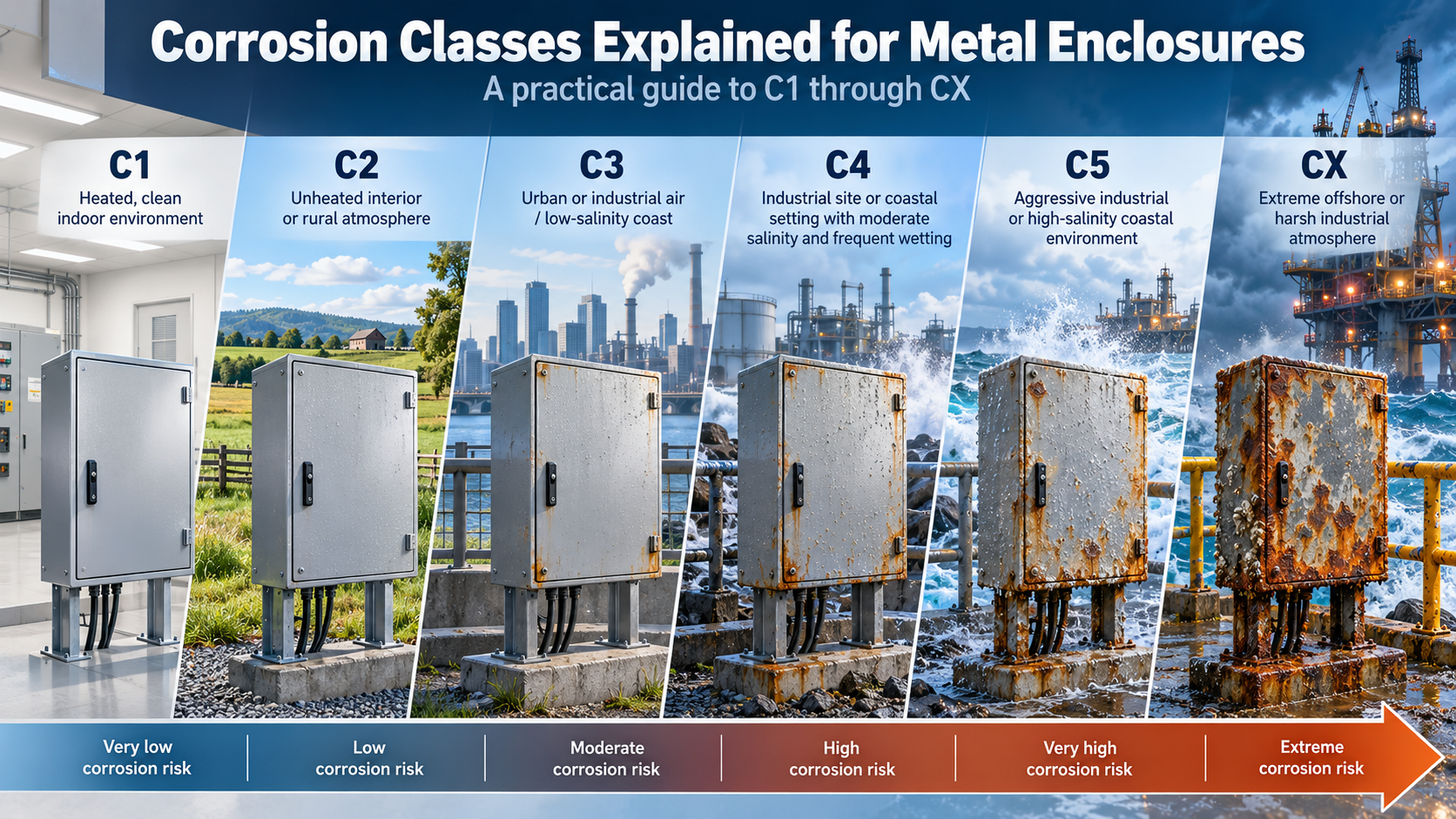
A dry electrical room, a busy industrial site and a salt-laden waterfront place very different demands on a metal enclosure. Corrosion classes give engineers a common way to describe atmospheric exposure, but the class alone does not select the sheet, coating or expected service life. A reliable specification connects the actual environment to the substrate, surface preparation, coating system, enclosure details and inspection plan.
What a corrosion class tells you
ISO 9223 classifies atmospheric corrosivity using the first-year corrosion rate of standard metal specimens. ISO 12944-2 uses environment categories as one input when selecting protective paint systems for steel structures. These standards describe exposure and provide a basis for system selection; they do not certify a particular enclosure material or coating by themselves.
The rates in the table are reference losses for unprotected standard carbon steel during the first year. They are not the predicted loss of a coated enclosure and should not be read as a coating-life calculator. ISO 9223 also cautions that it does not characterize every specific service atmosphere, including some chemical and metallurgical process environments. Where chemical splash, persistent condensation, washdown or unusual pollutants are present, assess those exposures separately.
Corrosion classes at a glance
Use the descriptions below as an initial screen. The exact microclimate at the enclosure can be more severe than the broad site description.
| Class | Level | Typical atmospheric setting | Carbon steel first-year rate |
|---|---|---|---|
| C1 | Very low | Heated, clean interiors such as offices, schools and hotels. | ≤ 1.3 µm/year |
| C2 | Low | Unheated interiors or rural atmospheres with low pollution; occasional humidity. | > 1.3 to 25 µm/year |
| C3 | Medium | Urban or industrial air with moderate pollution; coastal locations with low salinity. | > 25 to 50 µm/year |
| C4 | High | Industrial sites or coastal locations with moderate salinity and frequent wetting. | > 50 to 80 µm/year |
| C5 | Very high | Aggressive industrial atmospheres or coastal areas with high salinity. | > 80 to 200 µm/year |
| CX | Extreme | Extreme offshore or industrial exposure with severe atmospheric corrosion stress. | > 200 to 700 µm/year |
Older specifications may use C5-I for industrial exposure or C5-M for marine exposure. If either appears on a drawing, confirm which current category and exposure conditions the project intends; do not translate the legacy label into a material or coating prescription without review.
Read the location before choosing a finish
For an enclosure, the relevant exposure includes more than the town or distance from the sea. Salt deposits, industrial fallout, time of wetness, temperature swings and drying conditions all affect corrosion. The inside of an outdoor cabinet can also collect condensation, especially around seams, doors, cable entries and cold surfaces. In a washdown area, the cleaning chemical and rinse practice may matter as much as the general atmospheric category.
Start by describing where the enclosure sits, whether it is indoors or outdoors, how often it gets wet, what contaminants reach it, and whether water can drain and dry. Record the most aggressive face and the vulnerable details, including cut edges, folds, fasteners, hinges, welds and interfaces between dissimilar metals. That description turns a broad C class into a useful engineering brief.
Where EG sheet fits
Electrogalvanized (EG) sheet has a zinc layer applied by an electrolytic process. It offers a smooth, consistent base that can suit formed enclosure parts and decorative finishes. Its zinc coating is generally thinner than hot-dip galvanizing on fabricated steel, so the sheet designation and the paint system must be considered together. ASTM A879/A879M specifies electrolytically zinc-coated sheet by coating mass on each surface. State the required coating on both faces rather than relying on the word “EG” alone.
Before powder coating EG sheet, confirm the mill finish, oil, passivation or other surface treatment with the steel supplier and the pretreatment provider. These conditions influence cleaning and adhesion. Validate the complete formed part, not only a flat test panel: sheared edges, punched holes, hems, bends and joints can expose steel or make coating coverage less uniform. EG can be a practical choice when the complete substrate-and-finish system has been qualified for the intended environment; the sheet type alone does not assign a C class.
Match the substrate to the protection system
No material has a universal C-class approval. The table summarizes common enclosure substrates and the questions to resolve before release.
| Substrate | Why it is considered | Specification checks |
|---|---|---|
| Mild steel or CRCA | Economical and easy to form; corrosion protection comes from the finish system. | Set pretreatment, primer or powder, DFT and cure. Consider a compatible HDG duplex system for severe exposure. |
| EG sheet | Smooth electrolytic zinc coating; coating mass may differ by face. | Specify zinc mass per face. Check oil or passivation, then qualify the finish on representative formed edges. [3] |
| GI or Zn-Al sheet | Continuous zinc or zinc-aluminum coating adds metallic protection. | Name coating type and mass. Validate pretreatment and adhesion after forming; inspect sheared edges. |
| Stainless steel 304 or 316 | Useful base-metal corrosion resistance; 316 generally improves chloride resistance over 304. | 304 may pit in chlorides; 316 can still pit or crevice-corrode. Check welds, deposits and fasteners. |
| Aluminum | Lightweight with a protective oxide layer. | Choose alloy and finish for the exposure; isolate dissimilar-metal contact to limit galvanic attack. |
Standards scope matters for sheet products. ASTM D7803-25 covers preparation of hot-dip galvanized products and hardware for powder coating and expressly excludes galvanized sheet and coil. ASTM D7396-25 addresses continuous zinc-coated sheet preparation for liquid paint, not powder coating. Use process-specific supplier guidance and validate the actual sheet, pretreatment and powder combination.
Specify the whole coating system
Dry film thickness (DFT) is important, but a single thickness number cannot compensate for poor surface preparation, incomplete edge coverage, under-cure or a coating chemistry that does not fit the exposure. A powder-coating specification should identify the substrate and its metallic coating, cleaning and pretreatment, powder product and intended use, target DFT, cure schedule, inspection method, and acceptance criteria. Measure the part at representative locations and verify the thickness gauge for the substrate and coating combination using the applicable procedure. ASTM D7091 describes calibration, verification and adjustment steps for nondestructive DFT measurement.
Cure must be defined against the powder manufacturer's product data. For conveyor lines, verify the part's metal-temperature profile and time at temperature; oven-air temperature alone does not confirm cure through a thick or complex part. Keep production records for DFT, cure, pretreatment checks, powder usage and rework so the process can be traced when a finish issue appears.
Meklet's working reference includes example builds around 110–120 µm total DFT for one C3 mild-steel system and 200–250 µm for one C4 system. Treat these as examples for defined systems, not ISO-mandated minimums. The selected manufacturer's system data, substrate, geometry, exposure, test evidence and inspection plan determine the final build.
Interpret test reports in context
A test result describes a tested sample under a named method and acceptance rule. A supplier certificate reviewed for this article records one textured powder batch applied at 80 µm to 0.6 mm cold-rolled steel panels, with the report marking 500 hours of ASTM B117 salt spray and 300 hours of ASTM G154 QUV exposure as passing. Those results belong to that product, batch, panel preparation and test setup. They do not certify an enclosure as C5 or CX, establish performance on every substrate, or predict a number of years in service.
Salt spray is useful when the method and pass/fail criteria are agreed, but elapsed hours should not be converted directly into outdoor years. ISO 9227:2022 states that its salt-spray methods are not intended to rank different materials or predict long-term corrosion resistance. For a meaningful comparison, specify panel substrate, coating build, preparation, scribe condition if applicable, exposure method, duration, inspection points and acceptance criteria.
A practical specification checklist
- Describe the exposure. State location, indoor or outdoor service, wetting and drying, salt or industrial pollutants, chemical splash, washdown and condensation risk.
- Name the substrate. Specify steel or alloy, thickness, metallic coating type and coating mass on each face where applicable.
- Identify the coating build. List pretreatment, coating product or system, target DFT by layer, cure schedule and approved repair method.
- Cover vulnerable geometry. Address edges, folds, joints, welds, fasteners, drains, cable entries and dissimilar-metal contacts.
- Set acceptance criteria. Define visual inspection, DFT locations and gauge checks, adhesion or corrosion tests where required, test method and pass/fail rule.
- Plan inspection and maintenance. State how the enclosure will be checked after installation and how damaged finishes will be repaired.
Choose by exposure and verify the finished part
C1 through CX provide a shared language for atmospheric exposure, while reliable corrosion protection comes from matching that exposure to the complete enclosure design and finish. EG sheet can be an effective substrate when its coating designation, surface condition, pretreatment and powder finish are controlled as one system. For severe industrial or marine service, bring the enclosure designer, material supplier and coating supplier into the specification before production, then verify a representative finished assembly against clear acceptance criteria.
For a Meklet enclosure enquiry, share the installation environment, substrate preference, finish requirements and any project corrosion standard. That information gives the specification a practical starting point before manufacture.
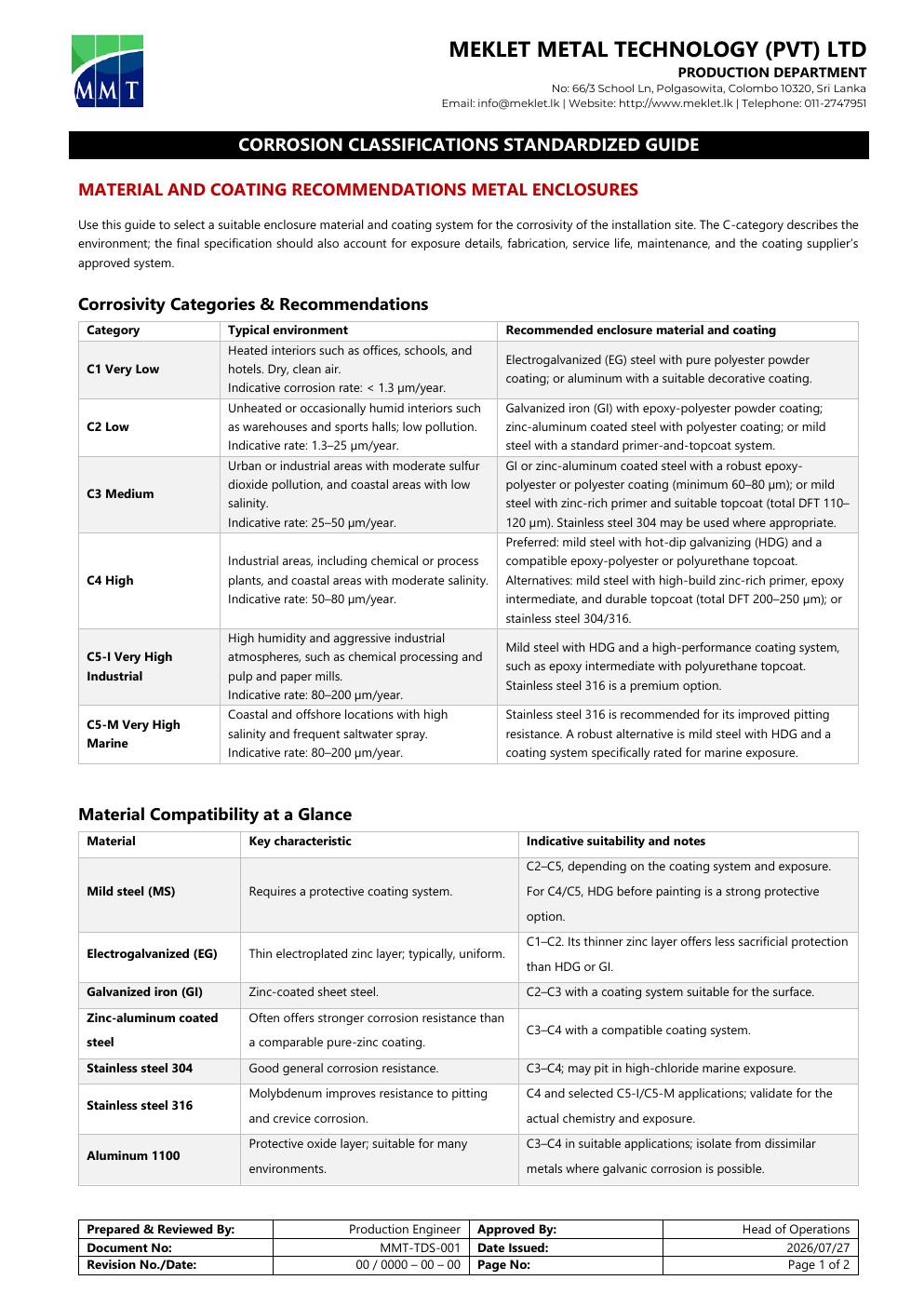 Preview PDF ↗
Technical reference · 2 pages
Corrosion Classifications Standardized Guide
Preview the first page here, or open the full guide for the classification tables and enclosure recommendations.
Open full guideStandards referenced
- ISO 9223:2012 - Corrosivity of atmospheres
- ISO 12944-2:2017 - Classification of environments
- ASTM A879/A879M-22 - Electrolytic zinc-coated steel sheet
- ASTM D7803-25 - Preparing hot-dip galvanized surfaces for powder coating
- ASTM D7396-25 - Preparing continuous zinc-coated steel for painting
- ISO 9227:2022 - Salt spray tests
- ASTM D7091-22 - Nondestructive dry film thickness measurement
- ASTM B117 - Salt spray (fog) apparatus practice
- ASTM G154-23 - Fluorescent ultraviolet exposure practice